Artificial intelligence call center agent are revolutionizing the way businesses handle customer service, turning routine support into a tool for growth and efficiency. With AI-driven call center technology, companies can use smart automation, natural language understanding, and intelligent call routing to provide faster, more consistent, and personalized experiences across calls, chats, and messaging. AI in call centers matters for business because it helps human agents focus on complex tasks while improving response times and overall customer satisfaction.
Modern AI call centers rely on cloud-based platforms for business operations, which allow companies to securely store and process large volumes of customer data. Integrated high-tech IT systems and computer infrastructure support seamless communication between AI agents and other software, giving businesses the ability to track customer behavior and predict needs. By connecting IoT-enabled devices to call center systems, companies gain real-time insights that enhance service quality and speed.
The power of AI extends beyond support into digital marketing using AI technology, enabling businesses to create targeted social media campaigns, predictive email strategies, personalized online advertising, and smarter content delivery. In the financial world, AI call center agents assist with automated financial processes, fraud detection, transaction tracking, and analysis of spending trends, improving operational efficiency and customer trust.
Combining cloud computing for call center technology, AI-driven marketing tools, IoT-connected customer data systems, and modern computer technology infrastructure creates a connected environment where an artificial intelligence call center agent does more than answer questions—it helps drive growth, improve operations, and unify customer experiences across departments.
With these integrated technologies, companies can leverage AI solutions for online marketing, AI-powered marketing customer analytics, smart business process automation, and intelligent financial management tools to make every customer interaction meaningful, efficient, and growth-oriented. This creates a high-tech ecosystem that supports better decision-making, stronger customer relationships, and measurable business results.
Top 10 AI Contact Center Solutions for Businesses
If you’re looking to improve customer service, reduce operational costs, and deliver smarter, faster interactions, choosing the right AI contact center solution is critical. Here’s a list of the top 10 platforms transforming customer support with artificial intelligence call center agents.
1. Bright Pattern – AI Contact Center Platform

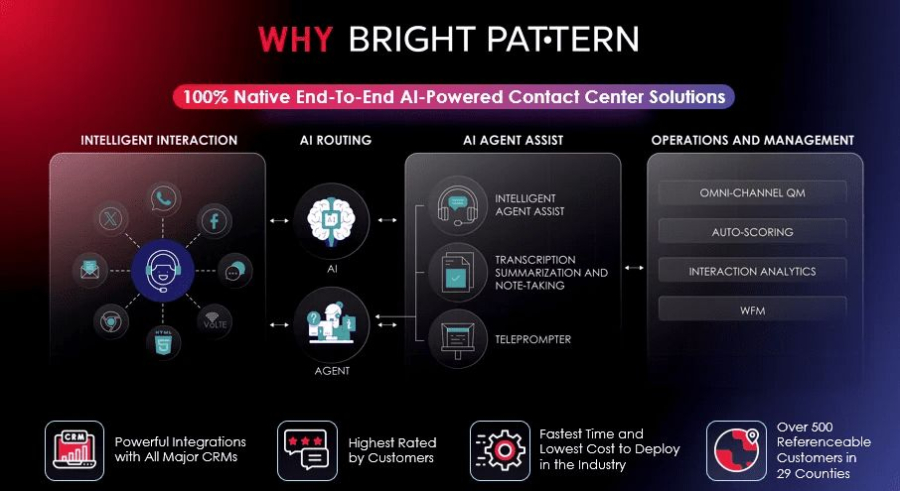
Bright Pattern leads the industry in providing AI contact center solutions that help businesses automate customer interactions and deliver personalized experiences at scale. Designed for both small teams and large enterprises, Bright Pattern integrates seamlessly with cloud technology and modern IT infrastructure.
Key features:
- AI-driven chatbots and virtual assistants for faster customer service
- Smart call routing to connect customers with the right agent quickly
- Omnichannel support across phone, chat, email, and messaging apps
- Real-time analytics to track agent performance and customer satisfaction
- Integration with CRM, marketing, and business intelligence platforms
- Scalable cloud-based deployment for global operations
Bright Pattern’s artificial intelligence call center agent capabilities make it easier for businesses to handle high volumes of inquiries, improve agent productivity, and enhance customer loyalty through consistent and personalized interactions.
2. Five9 – Cloud Contact Center Software
Five9 offers cloud-based AI solutions for call centers, including intelligent routing, predictive dialers, and AI-powered chatbots to enhance agent efficiency and customer satisfaction.
3. Genesys Cloud CX – Omnichannel Contact Center
Genesys Cloud CX provides AI-driven customer engagement tools, workforce optimization, and seamless omnichannel communication to deliver smarter support at scale.
4. NICE inContact – AI-Enhanced Call Center
NICE inContact combines cloud contact center software with AI analytics, natural language understanding, and automation to streamline customer interactions.
5. Talkdesk – AI-Powered Customer Experience Platform
Talkdesk uses AI to improve call routing, automate repetitive tasks, and deliver real-time insights, helping businesses provide faster, personalized support.
6. Cisco Contact Center – Intelligent AI Solutions
Cisco Contact Center integrates AI and machine learning to optimize agent workflows, improve customer experiences, and provide predictive analytics for better decision-making.
7. 8x8 Contact Center – Cloud-Based AI Platform
8x8’s AI-powered contact center platform includes chatbots, voice assistants, and analytics tools designed to enhance operational efficiency and customer engagement.
8. Zendesk – AI Support and Customer Service Tools
Zendesk leverages AI to automate support requests, provide smart suggestions for agents, and deliver personalized customer interactions across multiple channels.
9. RingCentral Contact Center – AI Solutions for Businesses
RingCentral provides AI-driven routing, speech analytics, and automation tools to help businesses improve response times and deliver consistent customer service.
10. Aspect Software – Intelligent Customer Engagement
Aspect Software offers AI-enabled workforce optimization, self-service tools, and omnichannel communication solutions to create more efficient and intelligent contact centers.
What Is an Artificial Intelligence Call Center Agent?
Anartificial intelligence call center agentis a software-based virtual agent that uses AI technologies to handle customer interactions that would traditionally be managed by a human agent. These AI agents can understand natural language, respond conversationally, execute tasks, and escalate issues when needed.
AI call center agents typically work across multiple channels, such as:
- Inbound voice calls (interactive voice response with natural language)
- Outbound calls (reminders, follow-ups, satisfaction checks)
- Live chat on websites or in apps
- Messaging platforms and SMS
Unlike rigid IVR menus of the past, modern AI agents can understand free-form speech or text, ask clarifying questions, and adapt to the flow of the conversation.
Key Benefits of AI Call Center Agents
The shift from traditional call centers to AI-augmented contact centers is driven by clear, measurable benefits. When implemented thoughtfully, an artificial intelligence call center agent can deliver value across operations, customer experience, and business growth.
1. 24/7 Availability Without Extra Headcount
Customers expect support around the clock, across time zones and devices. An AI call center agent never sleeps, never calls in sick, and can be available 24/7 without requiring night shifts or overtime.
This round-the-clock coverage helps you:
- Capture more sales opportunities outside standard business hours
- Support global customers without building regional teams immediately
- Handle urgent issues at any time, improving trust and loyalty
2. Faster Responses and Shorter Wait Times
AI agents can respond instantly, handle many conversations at once, and complete routine tasks in seconds. That means customers spend less time waiting on hold or repeating information.
By resolving common queries automatically, AI agents also reduce the queue for human agents, so when a customer does need human help, the wait time is much shorter.
3. Consistent, On-Brand Service Every Time
Human agents can have off days, miss details, or handle the same question inconsistently. An AI call center agent follows the latest approved policies, knowledge, and scripts every single time.
This consistency helps you:
- Ensure that customers receive accurate, compliant information
- Protect brand voice and tone across all interactions
- Standardize best practices and rapidly roll out updates to your entire support operation
4. Lower Cost Per Contact
Handling each call or chat with a human agent can be expensive when you include salaries, training, management, and turnover. An AI call center agent dramatically reduces the cost of handling simple, repetitive interactions.
Typical cost savings come from:
- Automating high-volume, low-complexity queries (for example, order status checks, password resets, appointment scheduling)
- Reducing average handle time by pre-collecting information before passing a call to a human agent
- Scaling to handle peak volumes without temporary hiring or outsourcing
5. Happier Agents and Reduced Burnout
AI does not replace your best agents; it empowers them. When AI agents handle repetitive tickets, human agents can focus on interesting, high-value conversations where empathy, negotiation, and creativity are critical.
This shift can lead to:
- Higher job satisfaction and engagement for your team
- Less burnout from constant queues of simple, repetitive calls
- More time for training, coaching, and proactive customer outreach
6. Rich Insights From Every Conversation
Every interaction managed by an AI call center agent can be automatically analyzed. AI can identify trending issues, emerging customer needs, and opportunities to improve products or processes.
Instead of manually sampling calls, you get a complete view of what customers ask, how often, and how effectively those queries are resolved.
How AI Call Center Agents Actually Work
Behind the scenes, an artificial intelligence call center agent uses a combination of technologies to understand, respond, and act.
Core Technologies
- Automatic Speech Recognition (ASR)converts spoken words into text so the system can interpret voice calls.
- Natural Language Understanding (NLU)analyzes text input to determine customer intent and extract key details, such as dates, names, or account numbers.
- Dialog Managementcontrols the flow of the conversation, deciding what to ask next, how to respond, and when to escalate.
- Text-to-Speech (TTS)turns AI responses into natural-sounding speech for voice calls.
- Integrations and APIsconnect the AI agent to your CRM, billing system, booking tools, and other back-end platforms.
The Typical Interaction Flow
- Customer initiates contact.They call, start a chat, or send a message.
- AI greets and authenticates.The AI agent welcomes the customer, may verify identity, and asks how it can help.
- AI detects intent.NLU determines the purpose of the request (for example, track order, change appointment, update billing details).
- AI executes tasks.Through integrations, the AI performs actions, such as searching an order, updating records, or creating a support ticket.
- AI confirms and closes.The agent confirms what it did, provides any reference details, and offers further help if needed.
- Smart escalation if required.For complex or sensitive issues, the AI passes the customer to a human agent, including full context to avoid repetition.
Top Use Cases for Artificial Intelligence Call Center Agents
AI agents can support a wide range of industries and use cases. Here are some of the most impactful applications.
Customer Service and E‑commerce
- Order status and delivery updates
- Return and refund inquiries
- Product information and availability
- Loyalty program questions
Banking and Financial Services
- Balance inquiries and recent transactions
- Card activation and replacement requests
- Branch or ATM information
- Basic loan or product explanations
Healthcare and Appointments
- Appointment booking, rescheduling, and reminders
- Directions and basic clinic information
- Insurance and coverage questions at a general level
Telecommunications and Utilities
- Bill explanations and payment confirmations
- Plan or package details
- Outage information and status checks
Internal Service Desks
- IT password resets and access requests
- HR policy questions
- Simple onboarding and offboarding tasks
AI Agents vs. Human Agents: A Powerful Partnership
AI agents are not a replacement for human empathy and judgment. Instead, they excel at what machines do best while humans focus on what they do best.
|
AI Call Center Agent Strengths |
Human Agent Strengths |
|
Handles high-volume, repetitive questions |
Manages complex, nuanced issues |
|
Available 24/7 at low marginal cost |
Builds rapport and deep relationships |
|
Provides consistent, policy-aligned answers |
Exercises flexible judgment and discretion |
|
Captures and analyzes every interaction |
Offers creativity, negotiation, and empathy |
The most successful contact centers design ahybrid modelwhere AI and humans work side by side: AI handles routine inquiries and triage, while human agents manage high-value conversations and complex resolutions.
Designing a Great AI Call Center Experience
Implementing an artificial intelligence call center agent is not just a technology project; it is an experience design exercise. Focusing on the following areas will help you launch quickly while still delivering quality.
1. Start With Clear Goals
Define what success looks like before you build anything. Common goals include:
- Reducing average wait time for customers
- Increasing first contact resolution for specific issue types
- Reducing cost per interaction while maintaining satisfaction
- Extending support hours without increasing team size
2. Identify High-Impact Use Cases
Analyze your current call and chat logs to find the most frequent, repetitive questions. These are ideal starting points because they are simpler to automate and generate immediate value.
Examples include:
- “Where is my order?”
- “How do I reset my password?”
- “What time do you open?”
3. Craft Conversational Flows
Even though an AI agent is software, customers experience it as a personality. Design prompts, clarifying questions, and responses that match your brand voice. Aim for:
- Clear, simple language
- Short messages, especially in chat
- Polite confirmations and summaries of actions taken
- Transparent handovers when a human agent is needed
4. Integrate With Your Existing Systems
The real power of an AI call center agent comes when it cando things, not just answer questions. Connecting it to your CRM, ticketing, order management, and scheduling systems allows the AI to:
- Look up customer records
- Update information in real time
- Create and route support tickets
- Trigger workflows such as confirmations or follow-up messages
5. Plan Smart Escalations
No AI agent can or should handle every scenario. Set clear escalation rules so that the AI knows when to transfer to a human, such as:
- Customer explicitly asks for a human
- High-value or sensitive topics, such as billing disputes
- Multiple failed attempts to understand the request
When escalating, the AI should pass along context, including a summary of the conversation so far, customer details, and actions already taken. This makes the transition smooth and respectful of the customer’s time.
6. Measure, Learn, and Improve
AI call center agents thrive on continuous learning. Track metrics such as:
- Containment rate (how many interactions the AI resolves without human help)
- Average handling time and wait time
- Customer satisfaction scores after AI interactions
- Top reasons for escalation to human agents
Use these insights to refine dialogs, update knowledge, and expand the set of tasks the AI can perform. Over time, the agent becomes smarter, more efficient, and more aligned with your customers’ needs.
Illustrative Scenarios: AI Agents in Action
To see the potential more clearly, consider a few practical scenarios. These are generic examples designed to show what is possible.
Retail and E‑commerce Example
A customer calls to ask about the status of a package. The AI call center agent:
- Greets the customer and asks for an order number.
- Looks up the order in the order management system.
- Provides real-time tracking information and estimated delivery time.
- Offers to send a confirmation message with the tracking link.
The entire process takes less than a minute, without involving a human agent.
Healthcare Appointment Example
A patient wants to reschedule a medical appointment. The AI agent:
- Authenticates the patient using basic verification.
- Retrieves upcoming appointments and confirms the one to change.
- Offers alternative time slots based on provider availability.
- Updates the calendar and sends a confirmation.
The patient gets instant help, and front-desk staff are free to focus on in-person patients.
How to Choose an AI Call Center Agent Solution
With many AI solutions available, selecting the right fit for your organization is crucial. Consider the following criteria when evaluating options.
1. Channel Coverage
Decide which channels matter most today and in the near future. Look for a platform that can support:
- Voice calls with natural language capabilities
- Web and in-app chat
- Messaging and SMS if your customers use those heavily
2. Integration Capabilities
Your AI call center agent should connect smoothly to your existing technology stack. Assess:
- Compatibility with your CRM or customer database
- Support for your telephony and contact center platforms
- APIs or connectors for ticketing, billing, and other core systems
3. Ease of Design and Management
Look for tools that enable non-technical staff to maintain and improve the AI experience, including:
- Visual conversation builders
- Simple ways to update knowledge and FAQs
- Built-in analytics and reporting
4. Language and Localization Support
If you serve customers in multiple regions, language support is essential. Evaluate:
- Available languages for speech recognition and text
- Quality of voices for text-to-speech
- Support for local formats such as dates, currencies, and addresses
5. Security, Privacy, and Compliance
Call centers often handle sensitive information. Ensure that your AI solution:
- Supports secure data transmission and storage
- Offers robust access controls and audit trails
- Can be configured to align with relevant regulations in your region and industry
Preparing Your Team for AI‑Powered Support
Successfully deploying an artificial intelligence call center agent also involves your people and processes.
Communicate the Vision
Explain to your team that AI is there to remove low-value work, not replace them. Highlight that AI allows agents to focus on:
- Complex problem solving
- Relationship building with key customers
- Upskilling and career growth
Involve Agents in Design
Your frontline agents know customers best. Involve them early by asking:
- Which questions are they asked most frequently?
- Where do customers get frustrated with existing processes?
- What would they automate first to make their work easier?
This collaboration leads to better AI experiences and stronger buy-in.
Provide Training on Working With AI
Teach agents how to collaborate with AI, for example:
- Reviewing AI transcripts and suggested responses
- Taking over escalated conversations efficiently
- Flagging gaps in AI knowledge for continuous improvement
The Future of AI in Call Centers
The capabilities of artificial intelligence call center agents are expanding rapidly. As models improve and integrations deepen, AI will be able to:
- Anticipate customer needs based on history and context
- Proactively reach out with helpful updates or reminders
- Support agents in real time with suggestions and knowledge
- Help leaders forecast demand and optimize staffing more accurately
Organizations that embrace AI thoughtfully and ethically will be able to deliver standout customer experiences while keeping costs under control and empowering their teams.
Conclusion: Turning Your Call Center Into a Strategic Advantage
An artificial intelligence call center agent is more than a new tool; it is a new way of thinking about customer service. By combining automation, intelligence, and human expertise, you can:
- Serve customers faster and more consistently
- Extend support hours without exploding costs
- Free your human agents to do higher-value work
- Continuously learn from every customer interaction
Organizations of all sizes can start small, automate targeted use cases, and build from there. With a clear strategy and a customer-first mindset, AI call center agents can transform your support operation into a powerful, always-on asset for growth.
